Quick Service & Work, We Assist You 24/7
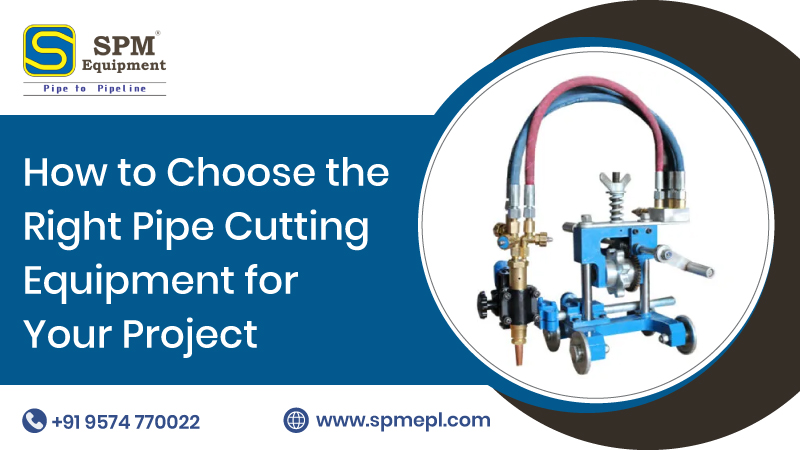
Selecting the right Pipe Cutting Machine is one of the most important decisions you’ll make for a piping project. The correct cutting system improves accuracy, speeds installation, reduces material loss, and lowers total project cost. Whether you work in fabrication, mechanical services, oil & gas, or plant maintenance, choosing a machine matched to pipe material, diameter, wall thickness, production volume, and site constraints is essential.
Why the right pipe cutter matters
A poor cutter choice shows up as burrs, out-of-round cuts, wrong bevels, slower throughput and ultimately higher labor and rework costs. In contrast, a suitable Pipe Cutting Machine gives consistent bevel geometry, repeatable square cuts, and clean surfaces ready for welding or joining.
For mobile field teams, portability and battery or petrol-driven power may be decisive; for fabrication shops, automation level, cycle time and consumable cost become the main drivers. Match your choice to the real constraints of jobsite and workflow rather than buying by brand or price alone.
Understand your cutting needs first
Start by clarifying the work the cutter must do. Break down requirements into clear, testable parameters:
- Pipe material and grade — carbon steel, stainless, duplex, super duplex, alloy, or nonmetallic pipes all behave differently under cutting forces.
- Pipe diameter range and wall thickness — define minimum and maximum sizes the machine must handle.
- Cut type — do you need square cuts, precise miter cuts, bevels for welding, or cross-cutting for spools?
- Production volume — is this for occasional site work, daily in-shop production, or long continuous shifts?
- Mobility and access — will cutters be used on scaffolding, in confined spaces, or in workshop bays?
- Power constraints — are there mains, three-phase, diesel or battery requirements on site?
Document these details clearly; they form the objective criteria to shortlist machines and to run pilot tests.
Types of pipe cutting equipment and when to choose them
There is a broad range of machines, each with advantages depending on the application:
- Cold-cut or rotary cutters — portable and popular for stainless and thin-wall pipes; they produce low heat and minimal burrs, suitable when heat-affected zones must be minimal. Great for in-situ work on welded systems.
- Band saws and circular saws — common in fabrication shops for clean, square cuts on thicker-walled pipes. They are faster for bulk cutting and give reliable material removal.
- CNC beveling and profiling machines — used when precise bevel geometry is required for automated welding. These are ideal for production lines and spool fabrication.
- CNC plasma or oxy-fuel cutters — appropriate for very large diameters or when profile cutting is needed, but they create heat-affected zones and need post-cut cleaning.
- Cut-and-bevel combination machines — integrate cutting and bevelling in one pass, saving time for welding prep on spools.
- Meter saws and chop saws — useful for simpler cuts at set angles in a shop environment.
Each machine type addresses distinct trade-offs: precision vs speed, portability vs automation, and heat generation vs cut cleanliness. Define which trade-offs you accept for your project before reviewing models.
Match cutting technology to pipe material
Different materials respond differently to cutting methods:
- For stainless and alloy piping, Pipe Cutting Machine s that perform cold cuts or use carbide blades are preferred because they minimize heat and preserve metallurgical properties. Cold cutting prevents discoloration and reduces the need for grinding or re-passivation.
- Carbon steel is commonly cut with saws or high-speed blades; for thick sections, abrasive cutting or plasma may be used depending on tolerance for HAZ (heat-affected zone).
- Composite and plastic pipes often need low-speed blades to avoid melt and produce clean edges. For these, specialized tooling and lower feed rates give the best results.
Knowing the primary materials, you will cut narrows the selection dramatically and points to required blade types and RPM ranges.
Consider operational factors: power, duty cycle and consumables
Operational realities drive long-term costs:
- Power source: Confirm whether mains power, diesel generator or battery operation is needed. Portable Pipe Cutting Machine s with battery options reduce logistic burdens but may limit run-time.
- Duty cycle: Industrial production demands high-duty machines built for continuous operation; light-duty machines will overheat and fail under continuous load.
- Consumables and spare parts: Blades, bands, inserts and grinding wheels are consumables—check their availability and unit costs. Machines with expensive, proprietary consumables can raise lifecycle costs.
- Ease of maintenance: Equipment designed with clear access to bearings, belts, and gear systems allows faster servicing and minimizes downtime.
- Safety features: Look for robust guarding, automatic shutoffs, and stable fixtures that protect operators and meet site safety standards.
Quantify expected runtime and consumable turnover for realistic lifecycle costing, not only initial purchase price.
Portability and workplace constraints
Site conditions often drive machine choice. Field teams may prefer compact Pipe Cutting Machines clamp to the pipe and cut in place, reducing the need to move heavy spools. But these machines sometimes sacrifice speed or multi-axis beveling capability.
Where work occurs inside confined spaces—ship tanks, on scaffolds, or in live plants—pay extra attention to machine footprint, weight, and ease of mounting. For workshops that move high volumes between bays, wheeled or gantry-mounted units with lifting points may be ideal.
Automation and integration: is CNC worth it?
Automation adds consistency and reduces operator dependence. CNC beveling or cut-and-bevel machines program bevel angles, cut lengths and profiles and reproduce them with repeatability across spools. For larger shops producing many identical parts or for projects where welders rely on consistent bevel geometry, CNC machines reduce rework and increase throughput. However, CNC systems cost more and require trained operators. Calculate the break-even point: divide the capital delta by expected monthly gains in productivity or reductions in rework to justify automation.
Safety and compliance
Any operator-facing machine must meet local safety regulations and be used with appropriate PPE. Confirm that the machine has necessary guarding, emergency stops, and lock-out features. For hazardous environments, explosion-proof or intrinsically safe equipment may be required. Also, check whether any cuts produce fumes or particulates that require extraction and filtration. A safe machine that reduces operator risk and meets compliance obligations reduces project risk and indirect costs.
Why Choose Us
SPM Equipment offers a wide portfolio of Pipe Cutting Machine solutions tailored for fabrication shops, construction sites, and industrial maintenance teams. We provide portable cold-cut machines, heavy-duty band saws, CNC beveling equipment, and complete cut-and-bevel systems designed to suit standard pipe materials and a wide range of diameters.
SPM Equipment provides technical selection support, on-site commissioning, operator training and accessible spare parts for long-term serviceability. Choosing SPM Equipment gives you practical guidance on matching cutting technology to project needs, backed by local service and product documentation to keep machines productive and operators confident.
Conclusion
Choosing the right pipe cutting equipment transforms delivery, safety and long-term cost. Start by matching pipe material and diameter to cutting technology — abrasive wheels for thick carbon steel, cold cutting for stainless, and band or saw systems for larger diameters.
Consider portability, automation level, cutter speed, precision, and consumable availability when comparing models. Evaluate duty cycle, power source and maintenance access to predict uptime. Factor operator training, spare parts lead time, and total cost of ownership rather than only purchase price. Test candidate machines on representative workpieces. With informed selection, projects finish faster, cleaner and at lower lifecycle cost.
For expert advice on choosing the ideal Pipe Cutting Machine for your project, contact SPM Equipment today for quotes and technical guidance: Call +91 9574770022 or email sales@spmepl.com.
Key Takeaways
- Selecting the right pipe cutting machine directly impacts project quality and cost
A well-matched Pipe Cutting Machine delivers clean, accurate cuts, reduces rework, improves welding fit-up, and lowers overall labor and material waste. - Understanding cutting requirements is the first and most critical step
Pipe material, diameter, wall thickness, cut type, production volume, mobility needs, and power availability must be clearly defined before choosing any cutting system. - Different cutting technologies suit different applications
Cold cutting is ideal for stainless and alloy pipes, band saws and circular saws suit shop fabrication, while CNC cut-and-bevel machines are best for high-precision, high-volume production. - Operational factors determine long-term ownership value
Duty cycle, consumable cost, spare part availability, ease of maintenance, safety features, and power source have a major influence on uptime and total cost of ownership. - Expert guidance ensures the right technology match
SPM Equipment supports buyers with technical selection assistance, training, commissioning, and reliable after-sales service—helping projects achieve faster completion, safer operation, and consistent cutting accuracy.
Frequently Asked Questions (FAQs)
Which cutting method is best for stainless steel pipe?
For stainless steel, cold-cut methods and carbide-tooth blades on band saws often give the cleanest cuts with minimal heat-affected zone. Choose a Pipe Cutting Machine that limits thermal distortion for welded systems.
Can a portable pipe cutter handle large diameter mains?
Portable clamping cutters work well up to moderate diameters. For very large mains you will likely need shop-mounted band saws, CNC plasma or specialized beveling machines designed for large diameters.
How do I compare consumable costs between models?
Calculate cost per cut: divide blade or wheel cost by expected life (cuts per consumable) and add operator time. Machines that use inexpensive, commonly available consumables usually yield lower lifecycle expense.
Is CNC beveling necessary for small fabricators?
CNC beveling pays back when you have high volume, need repeatable bevel accuracy, or want to reduce welder rework. For occasional jobs, manual or semi-automatic beveling may be sufficient.
What safety checks should be done before using a Pipe Cutting Machine on site?
Verify guarding, emergency stop function, correct blade or wheel mounting, secure pipe clamping, appropriate PPE, and that extraction or ventilation is available for fume-generating processes.